
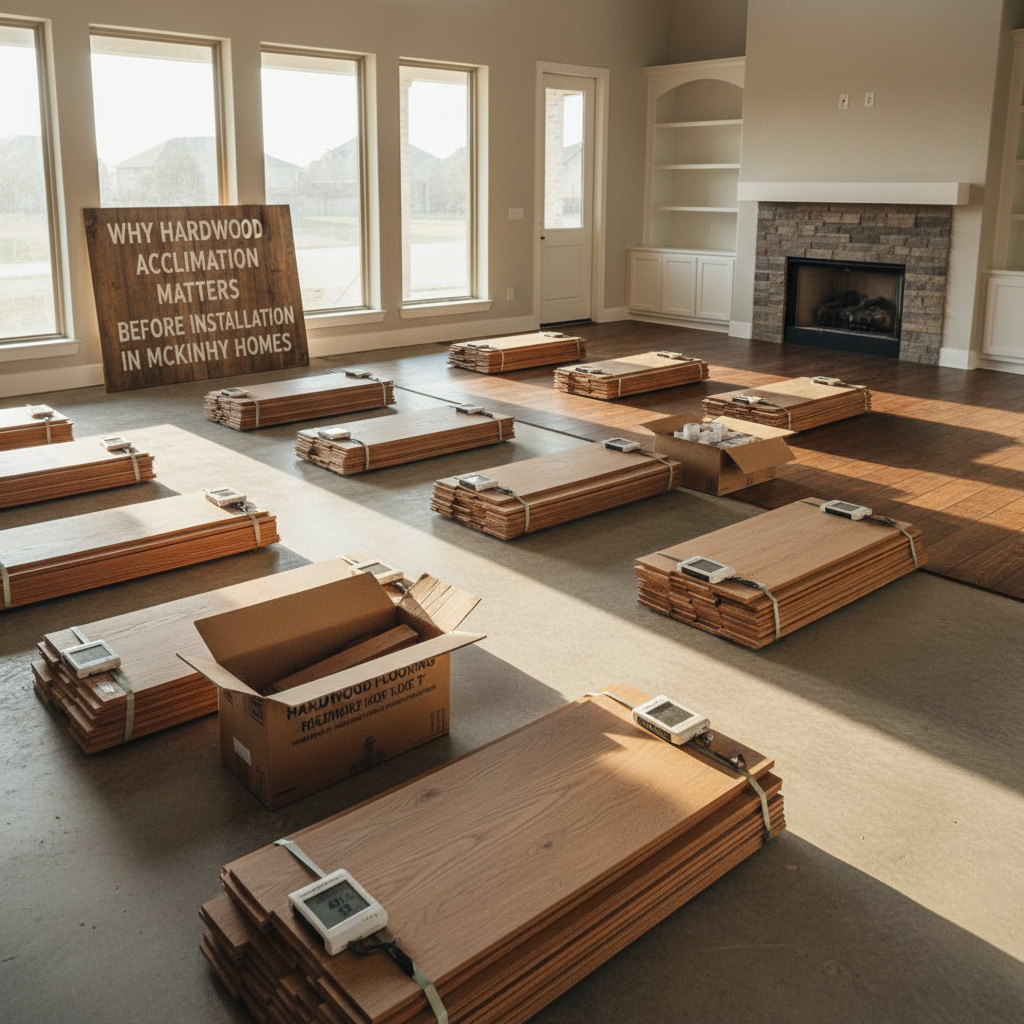
Installing new solid hardwood or engineered hardwood flooring is a significant upgrade for any McKinney home. However, long before the first board is nailed or glued down, a critical step must take place: acclimation. In North Texas, where weather conditions swing from humid summer stretches to crisp, dry winter fronts, proper acclimation protects your investment against long-term structural issues.
At McKinney Hardwood Flooring, we view acclimation not as an optional suggestion, but as an essential phase of professional installation. Understanding how natural wood interacts with your home's indoor environment helps ensure your new floors remain flat, stable, and beautiful for decades to come.
Understanding Wood and North Texas Humidity
Wood is a hygroscopic material, meaning it naturally absorbs and releases moisture depending on the relative humidity of its surrounding environment. When air is humid, wood fibers take in moisture and expand. When the air dries out, wood expels moisture and contracts.
Collin County experiences notable seasonal humidity shifts. During peak summer months, outdoor humidity levels can sit well above 70 percent, while indoor air conditioning runs constantly. In the winter, heating systems dry out interior air. If wood planks are delivered from an unconditioned warehouse or transit truck and installed immediately, they will attempt to balance their moisture content while already fastened to your subfloor. This rapid movement often causes preventable flooring failures.
What Happens When Hardwood Is Not Acclimated?
Rushing into installation without allowing the flooring material to reach Equilibrium Moisture Content (EMC) leads to visible and structural problems over time:
- Cupping: Occurs when the bottom of a plank absorbs moisture from the subfloor faster than the top can release it, causing the plank edges to curl upward.
- Crowning: The reverse of cupping, where the center of the board bulges higher than the edges due to surface moisture exposure or improper drying after moisture exposure.
- Buckling: Severe expansion where boards push against each other with enough force to lift off the subfloor entirely.
- Excessive Gapping: When wood is installed at a high moisture level and subsequently dries out in a climate-controlled home, wide, unsightly spaces form between boards.
Solid Hardwood vs. Engineered Hardwood Acclimation
Both solid hardwood and engineered hardwood require moisture monitoring before installation, but their structural differences affect how they adapt to your space.
Solid hardwood is milled from a single piece of timber and reacts noticeably to atmospheric moisture. It typically requires several days inside the home with boxes opened and cross-stacked to allow air circulation. The installation should only proceed when the moisture level of the wood is within a safe range relative to the subfloor.
Engineered hardwood is constructed with a real hardwood veneer atop cross-layered plywood or high-density core material. This layered design gives it greater dimensional stability against humidity swings. While engineered planks may require a shorter acclimation window than solid wood, temperature and moisture equalization remain necessary to ensure manufacturer adhesives and interlocking profiles perform as intended.
Key Conditions for Proper Acclimation in McKinney
Effective acclimation is determined by moisture readings and environmental control, not simply by setting boxes in a room and watching a calendar. Before installation, several baseline conditions must be met:
- Active HVAC Operation: The home heating and cooling system must be fully operational, maintaining standard living conditions (typically 60 to 80 degrees Fahrenheit and 30 to 50 percent relative humidity) for at least five to seven days prior to delivery.
- Enclosed Structure: All exterior doors, windows, and drywall work must be complete. Wet trades, such as painting and drywall mudding, release heavy moisture into the air and should be finished beforehand.
- Subfloor Testing: Wood and concrete subfloors must be evaluated with calibrated pin or pinless moisture meters. The difference in moisture between solid wood flooring and a wood subfloor should typically not exceed two to four percent depending on board width.
- Proper Storage: Planks should be stacked neatly inside the specific rooms where they will be installed, elevated off concrete slabs and away from direct sunlight or exterior doorways.
Consult McKinney Hardwood Flooring for Expert Installation
Proper acclimation and subfloor moisture testing require professional tools and local experience. McKinney Hardwood Flooring provides comprehensive in-home consultations throughout McKinney, TX, helping homeowners select the right hardwood, engineered hardwood, laminate, vinyl plank, or carpet for their property.
Whether you are replacing worn carpet with rich hardwood or planning a full home floor removal and installation, our team manages every step with precision. Contact McKinney Hardwood Flooring today to schedule your consultation and ensure your next flooring project is built on a solid foundation.


